
Join the discussion
Question 20/55
Refer to the exhibit.
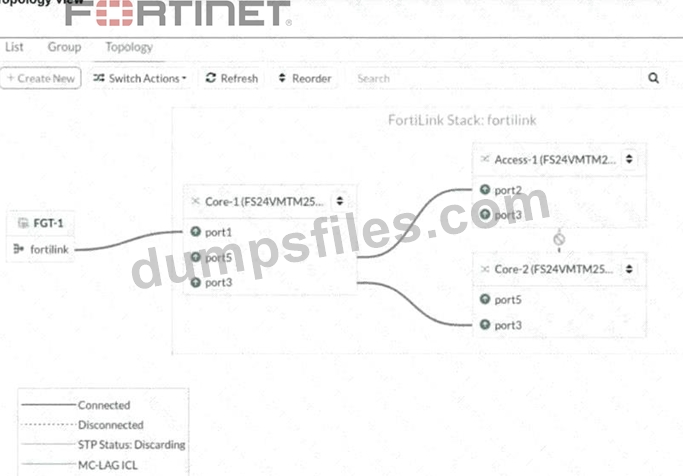
You just connected three FortiSwitch devices:Core-1,Core-2, andAccess-1. Core-1 and Core-2 both connect to Access-1 for redundancy. All switches are managed by FortiGate, which uses port4 as the FortiLink interface. After you enable the uplink ports on Core-2, you notice that port3 on Access-1 enters the Discarding STP state. What is the most likely cause of this behavior? (Choose one answer)
You just connected three FortiSwitch devices:Core-1,Core-2, andAccess-1. Core-1 and Core-2 both connect to Access-1 for redundancy. All switches are managed by FortiGate, which uses port4 as the FortiLink interface. After you enable the uplink ports on Core-2, you notice that port3 on Access-1 enters the Discarding STP state. What is the most likely cause of this behavior? (Choose one answer)
Correct Answer: C
According to theFortiSwitchOS 7.6 Administration Guideand theFortiLink 7.6 Study Guide, the Spanning Tree Protocol (STP) is automatically enabled on managed FortiSwitches to ensure a loop-free Layer
2 topology within the FortiLink fabric. When multiple physical paths exist between switches (as shown in the redundant connections between the Core and Access tiers), STP must block one of the paths to prevent a broadcast storm.
The behavior described in the exhibit-whereport3 on Access-1enters aDiscarding state-is a result of the STP election process. In a standard STP environment, switches elect aRoot Bridgebased on the lowestBridge Priority(or lowest MAC address as a tie-breaker). Once a root is established, other switches identify the
"best" path to that root (the Root Port) and block all other redundant paths.
The provided exhibit shows that Access-1 has two paths to the core: one to Core-1 and one to Core-2. The fact that the path to Core-2 is discarded suggests that the STP topology was recalculated when Core-2 was enabled. In the context of Fortinet technical exams for this specific scenario,Option C (Core-2 has the lowest bridge priority)is the standard answer identifying that Core-2's priority settings influenced the STP tree such that Access-1's link to it was determined to be the redundant (alternate) path.
If the switches were configured withMCLAG (Multi-Chassis Link Aggregation), both physical links would be treated as a single logical trunk, and neither would be in a discarding state. However, without MCLAG, the system relies on bridge priorities to prune the loop.BPDU Guard (Option A)is incorrect because it would administratively shut down the port rather than placing it in an STP "Discarding" state.Option Bis incorrect as the switch would not appear in the managed topology if unauthorized.
2 topology within the FortiLink fabric. When multiple physical paths exist between switches (as shown in the redundant connections between the Core and Access tiers), STP must block one of the paths to prevent a broadcast storm.
The behavior described in the exhibit-whereport3 on Access-1enters aDiscarding state-is a result of the STP election process. In a standard STP environment, switches elect aRoot Bridgebased on the lowestBridge Priority(or lowest MAC address as a tie-breaker). Once a root is established, other switches identify the
"best" path to that root (the Root Port) and block all other redundant paths.
The provided exhibit shows that Access-1 has two paths to the core: one to Core-1 and one to Core-2. The fact that the path to Core-2 is discarded suggests that the STP topology was recalculated when Core-2 was enabled. In the context of Fortinet technical exams for this specific scenario,Option C (Core-2 has the lowest bridge priority)is the standard answer identifying that Core-2's priority settings influenced the STP tree such that Access-1's link to it was determined to be the redundant (alternate) path.
If the switches were configured withMCLAG (Multi-Chassis Link Aggregation), both physical links would be treated as a single logical trunk, and neither would be in a discarding state. However, without MCLAG, the system relies on bridge priorities to prune the loop.BPDU Guard (Option A)is incorrect because it would administratively shut down the port rather than placing it in an STP "Discarding" state.Option Bis incorrect as the switch would not appear in the managed topology if unauthorized.
Add Comments

- Other Question (55q)
- Q1. Exhibit. Which configuration change will allow the managed FortiSwitch to accept SNMP requ...
- Q2. Which statement about the IGMP snooping querier when enabled on a VLAN is true?...
- Q3. Refer to the exhibit. (Exhibit) The profile shown in the exhibit is assigned to a group of...
- Q4. Which two statements about managing a FortiSwitch stack on FortiGate are true? (Choose two...
- Q5. Which two statements about VLAN assignments on FortiSwitch ports are true? (Choose two.)...
- Q6. What does the switchauto-networksetting control on FortiSwitch? (Choose one answer)...
- Q7. Refer to the exhibit. (Exhibit) Core-1 and Access-1 are managed and authorized by FortiGat...
- Q8. Refer to the exhibits. (Exhibit) You are reviewing a FortiSwitch configuration where port1...
- Q9. Refer to the exhibits. (Exhibit) An administrator has deployed two FortiSwitch devices, Co...
- Q10. You are deploying a new FortiSwitch device in a branch office and you want it to be automa...
- Q11. Refer to the exhibit. (Exhibit) The exhibit shows the current status of the ports on the m...
- Q12. You are configuring FortiSwitch to perform layer 3 inter-VLAN routing while managed by For...
- Q13. What type of multimode transceiver can be used to split a 40G port?...
- Q14. Refer to the exhibit. (Exhibit) The security port policy is configured as shown in the exh...
- Q15. Which drop policy mode, if assigned to a congested port, will drop incoming packets until ...
- Q16. On supported FortiSwitch models, which access control list (ACL) stage is recommended for ...
- Q17. How does FortiSwitch perform actions on ingress and egress traffic using the access contro...
- Q18. Which feature should you enable to reduce the number or unwanted IGMP reports processed by...
- Q19. Refer to the diagnostic output: What makes the use of the sniffer command on the FortiSwit...
- Q20. Refer to the exhibit. (Exhibit) You just connected three FortiSwitch devices:Core-1,Core-2...
- Q21. Refer to the exhibits. (Exhibit) Three FortiSwitch devices in standalone mode are intercon...
- Q22. Refer to the exhibit. (Exhibit) The security port policy is configured as shown in the exh...
- Q23. Refer to the exhibit. (Exhibit) Which two configurations can you use for the FortiLink int...
- Q24. Refer to the exhibit. What two conclusions can be made regarding DHCP snooping configurati...
- Q25. Exhibit. (Exhibit) What conditions does a FortiSwitch need to have to successfully configu...
- Q26. Refer to the diagnostic output: What makes the use of the sniffer command on the FortiSwit...
- Q27. You need to mirror traffic from a source port on Switch A to a monitoring device on Switch...
- Q28. Refer to the exhibit. (Exhibit) The command diagnose switch physical-ports summary is exec...
- Q29. You are deploying a multitier FortiSwitch topology with redundant links between access and...
- Q30. Refer to the exhibits. (Exhibit) All three FortiSwitch-connected ports are configured in V...
- Q31. Exhibit. port24 is the only uplink port connected to the network where access to FortiSwit...
- Q32. Refer to the exhibit. (Exhibit) PC1 connected to port1 has joined multicast group 225.1.2....
- Q33. (Full question statement start from here) You are deploying a FortiSwitch virtual stack in...
- Q34. Refer to the exhibit. (Exhibit) You have just authorized a new FortiSwitch on your FortiGa...
- Q35. Refer to the exhibits. (Exhibit) All three FortiSwitch-connected ports are configured in V...
- Q36. Refer to the exhibits. An IP phone is connected to port1 of FortiSwitch Access-1. The IP p...
- Q37. (Full question statement start from here) You enable Dynamic Host Configuration Protocol (...
- Q38. Which two statements about 802.1X authentication on FortiSwitch ports are true? (Choose tw...
- Q39. What are two ways in which automatic MAC address quarantine works on FortiSwitch? (Choose ...
- Q40. Refer to the exhibits. (Exhibit) Three FortiSwitch devices in standalone mode are intercon...
- Q41. Refer to the diagnostic output: (Exhibit) Two entries in the exhibit show that the same MA...
- Q42. What does the switchauto-networksetting control on FortiSwitch? (Choose one answer)...
- Q43. Your team is deploying a single FortiGate and a single FortiSwitch across 100 branch offic...
- Q44. Refer to the exhibit. (Exhibit) After reviewing the CLI command output, which two conclusi...
- Q45. (Full question statement start from here) When you change FortiSwitch management mode from...
- Q46. Which packet capture method allows FortiSwitch to capture traffic on trunks and management...
- Q47. How does FortiGate handle configuration of flow tracking sampling if you export the settin...
- Q48. You are configuring VLANs on a FortiSwitch device managed by FortiGate. Which two statemen...
- Q49. You are managing FortiSwitch ports from a FortiGate device with multiple VDOMs. Which two ...
- Q50. Refer to the exhibit. (Exhibit) You configured Switched Port Analyzer (SPAN) to monitor tr...
- Q51. What does the switchauto-networksetting control on FortiSwitch? (Choose one answer)...
- Q52. Refer to the exhibit. (Exhibit) The command diagnose switch physical-ports summary is exec...
- Q53. You are designing a multi-tenant network using FortiSwitch devices in standalone mode. Sec...
- Q54. What does the switchauto-networksetting control on FortiSwitch? (Choose one answer)...
- Q55. Refer to the exhibit. (Exhibit) and an OSPF route with destination 0.0.0.0/0 [110/10]. The...

[×]
Download PDF File
Enter your email address to download Fortinet.NSE5_FSW_AD-7.6.v2026-11-03.q55.pdf