
Join the discussion
Question 1/25
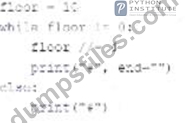
How many hashes (+) does the code output to the screen?
Correct Answer: C
The code snippet that you have sent is a loop that checks if a variable "floor" is less than or equal to 0 and prints a string accordingly. The code is as follows:
floor = 5 while floor > 0: print("+") floor = floor - 1
The code starts with assigning the value 5 to the variable "floor". Then, it enters a while loop that repeats as long as the condition "floor > 0" is true. Inside the loop, the code prints a "+" symbol to the screen, and then subtracts 1 from the value of "floor". The loop ends when "floor" becomes 0 or negative, and the code exits.
The code outputs five "+" symbols to the screen, one for each iteration of the loop. Therefore, the correct answer is C. five.
Reference: [Python Institute - Entry-Level Python Programmer Certification]
floor = 5 while floor > 0: print("+") floor = floor - 1
The code starts with assigning the value 5 to the variable "floor". Then, it enters a while loop that repeats as long as the condition "floor > 0" is true. Inside the loop, the code prints a "+" symbol to the screen, and then subtracts 1 from the value of "floor". The loop ends when "floor" becomes 0 or negative, and the code exits.
The code outputs five "+" symbols to the screen, one for each iteration of the loop. Therefore, the correct answer is C. five.
Reference: [Python Institute - Entry-Level Python Programmer Certification]
Add Comments

- Other Question (25q)
- Q1. How many hashes (+) does the code output to the screen? (Exhibit)...
- Q2. What is the expected result of the following code? (Exhibit)...
- Q3. What is the expected output of the following code? (Exhibit)...
- Q4. Drag and drop the conditional expressions to obtain a code which outputs * to the screen. ...
- Q5. Arrange the binary numeric operators in the order which reflects their priorities, where t...
- Q6. What is the expected output of the following code? (Exhibit)...
- Q7. What is the expected output of the following code? (Exhibit)...
- Q8. What happens when the user runs the following code? (Exhibit)...
- Q9. Drag and drop the literals to match their data type names. (Exhibit)...
- Q10. Python Is an example of which programming language category?...
- Q11. What is the expected output of the following code? (Exhibit)...
- Q12. What is the expected output of the following code? (Exhibit)...
- Q13. What happens when the user runs the following code? (Exhibit)...
- Q14. What is true about exceptions and debugging? (Select two answers.)...
- Q15. What is the expected result of the following code? (Exhibit)...
- Q16. Which of the following functions can be invoked with two arguments?...
- Q17. Arrange the binary numeric operators in the order which reflects their priorities, where t...
- Q18. What is the expected output of the following code? (Exhibit)...
- Q19. Arrange the code boxes in the correct positions to form a conditional instruction which gu...
- Q20. Insert the code boxes in the correct positions in order to build a line of code which asks...
- Q21. What is the expected output of the following code? (Exhibit)...
- Q22. Drag and drop the literals to match their data type names. (Exhibit)...
- Q23. Assuming that the phonc_dir dictionary contains namemumber pairs, arrange the code boxes t...
- Q24. What happens when the user runs the following code? (Exhibit)...
- Q25. Assuming that the phonc_dir dictionary contains namemumber pairs, arrange the code boxes t...

[×]
Download PDF File
Enter your email address to download PythonInstitute.PCEP-30-02.v2025-12-15.q25.pdf